

Issues and Solutions
In an era where our communities are under attack by the special interests and cuts to programs from President Trump and Republicans in Congress and Columbus, we must work with determination and speed to mitigate the harms of these cuts.
But we must not simply fight against the Republican cuts - we need to fight for a better region.
Now is the time for Democratic Party leaders, including our elected officials, to fully embrace the moral clarity of healthcare and housing as human rights.
When the most vulnerable in our community thrive, we all thrive.
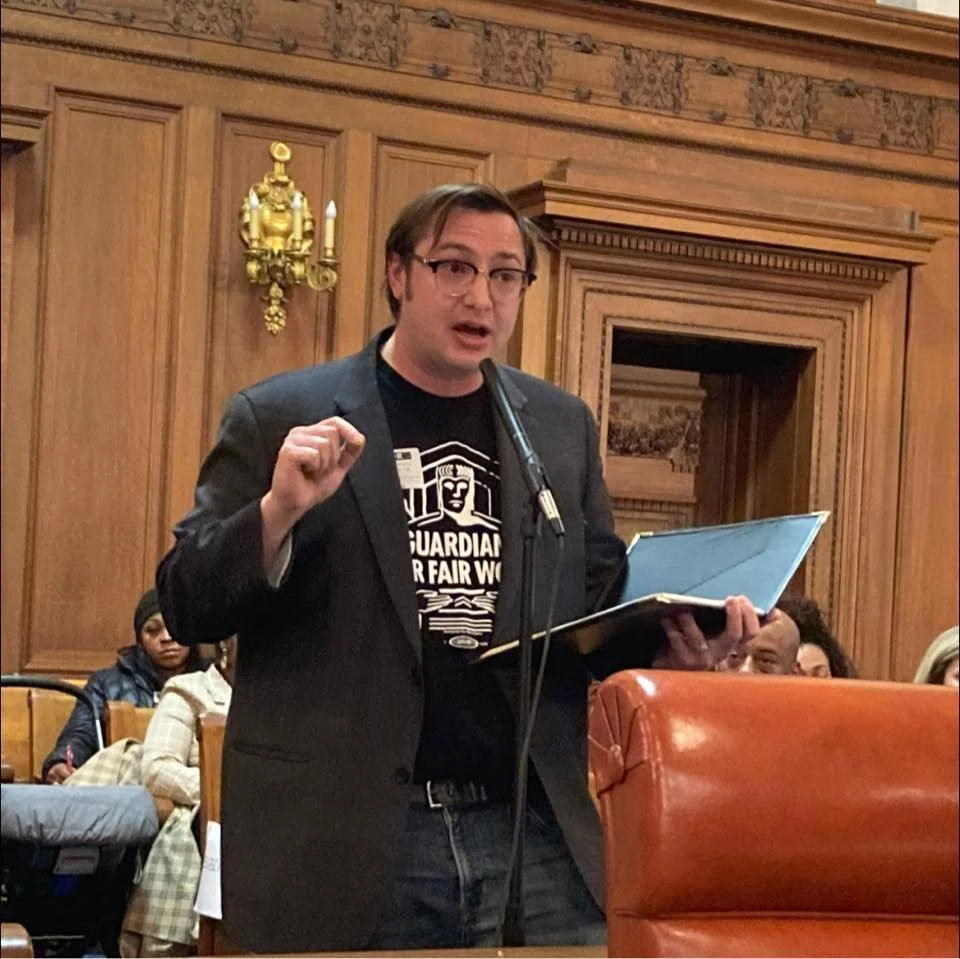
Affordable Housing, Healthcare, energy, and taxes
We all deserve a safe and affordable place to call home. For many of us, home affordability is what brought us, our parents, or our grandparents to the greater Cleveland region.
But a broken housing market fueled by Wall Street greed and higher interest rates, along with decades of politicians letting the wealthy rig the tax code against working class neighborhoods are pushing many of our communities to a breaking point.
As a member of County Council, Justin will work to take an all-of-government approach to provide pathways to stability and affordability today and for future generations.
Because local governments can and should be the first and best line of defense when it comes to protecting affordability on issues ranging from housing and healthcare to energy and taxes.
-
Justin believes that it is critical to listen to frontline workers in the healthcare field, from nurses to doctors to social workers.
You can read the full Healthy and Affordable Cuyahoga Action Plan below, which is rooted in addressing the Social Drivers of Health (SDoH) as laid out by the federal Healthy People 2030 project.
-
As your Democratic member of County Council, Justin will work to provide pathways to stability and permanently affordable housing for future generations.
This includes working with stakeholders including local unions, municipalities, and residents to:
Bring sunlight into the murky marketplace of contractors to make it easier for residents to find local, licensed companies to make the improvements needed on their homes by establishing a public contractors marketplace
Clarify and streamline existing programs and benefits for seniors, veterans, and parents into one easy to use system and to the greatest extent possible under federal and state law, automatically opts them in instead of putting the burden on residents to navigate an increasingly complicated tax code
Take an all-of-government approach accelerate lead remediation from homes to protect the health of children, adults, and seniors
Support homeowners’ ability to expand on their property through accessory dwelling unit (ADU) incentives to promote multi-generational housing and to provide income potential for owner-occupied homes
Drawing from best practices around the country, create cooperative ownership entities that can work with local municipalities and land trusts to restore neglected multi-unit buildings that have long been held as tax havens by wealthy portfolio managers and reclaim blighted neighborhoods to a state of vibrancy
Work with local landlords to identify pain points and solutions on issues from permitting to tax incentives that would better protect and promote local, ethical property management solutions and mitigate the influence of out of state investors extracting wealth from our neighborhoods
Work with County Council to implement a countywide vacancy tax targeted at the shell companies of wealthy developers and asset managers who hold onto the property as tax write-offs
Develop proactive tenants rights education and expand on the progress made by Cleveland by ensuring right-to-counsel countywide
-
Cleveland is poised to be a climate-stable region, but only if we invest in sustainable energy infrastructure immediately. For decades, state and local politicians have conspired with First Energy against the public to keep their monopoly on power—figuratively and literally. With each passing year, our energy costs go up and the durability of the grid goes down.
As your Democratic member of County Council, Justin will work to improve our region’s energy affordability, efficiency, independence, and climate sustainability.
This includes working with stakeholders to bring together federal, state, county, and municipal officials, local unions, and residents to:
Leverage and expand our public power infrastructure so that our communities directly benefit from investments in solar, wind, and hydropower.
Specifically support the use of county financing to supercharge Cleveland Public Power to provide solar panels to residents of Cleveland at no-cost
Advocate for ways to climate-proof our electric grid, such as by burying powerlines to prevent critical infrastructure failures that lead to life and business threatening power outages
-
Our tax code is rigged against working people and too often pits the suburbs against Cleveland and one another when it comes to competing for local resources.
How we fund state and local government is increasingly unaffordable, both for the programs needed for strong communities and for the residents who pay more and more every year in property taxes that hurt working people while being largely avoided by the wealthy and well-connected.
Justin has experience working on progressive tax policy at the federal level and is excited to bring that knowledge and passion to local government.
Extremists in the Statehouse recently eliminated the limited progressive tax system to give big tax cuts to those who make over six-figures, which will only result in further cuts to local funding streaming back to localities.
Meanwhile, for over 200 years, property taxes have funded much of state and local government. When that model was first enacted, property ownership was a good proxy for wealth. That’s no longer the case.
Today, most people’s homes are their only major asset, and it’s an asset they worked hard for. But taxes on that asset have gone up over 30% in the last five years, and working peoples’ paychecks haven’t kept pace.
Further, the county’s other principal lever to raise revenue is the sales tax, which is regressive and anti-family. Cuyahoga residents currently pay 8% on all of their purchases, which is the highest in the state of Ohio. While much of this revenue is used for profoundly important projects, it also funds the monstrosity of a project for a new billion dollar jail that moves those awaiting their day in court to be further away from justice.
Justin will fight everyday to make sure how we fund critical local services more affordable and equitable so that working people can keep their homes and more money in their pockets.
-
We have a criminal legal system that for too long has focused on protecting the interests of the wealthy and well-connected while targeting people of color and the poor.
Having worked as an advocate for cannabis legalization with a focus on civil liberties for nearly a decade as the federal lobbyist for NORML and later founding Better Organizing to Win Legalization, Justin has worked with stakeholders from all around the country on addressing local, state and federal reforms.
Given that the War on Drugs is so entwined with the criminal legal system, Justin has experience working on aspects of reform from reentry programs to expungements, and from gun control to immigration and everything in between.
There is much that needs to be addressed here in Cuyahoga County to build a legal system that lives up to the American promise of “liberty and justice for all” and Justin is excited to continue to fight to make that a reality.
This will require working with stakeholders throughout the county to:
Do everything possible to steer away from the project to spend over a billion dollars on a new jail that further removes those who await trial from the courthouse
Work to establish a Wage Theft Division in the office of the County Prosecutor to address the scourge of wage theft inflicted upon workers, disproportionately of who make low wages or come from marginalized backgrounds
Expand support for municipalities to move towards co-responder and community policing models to allow law enforcement to focus on violent and property crimes and not mental health or other issues that would be better addressed from a care perspective
Work with residents and community leaders everyday to identify and address fundamental safety concerns that are foundational to building a Healthy and Affordable Cuyahoga
A healthy and affordable cuyahoga action plan
Social Drivers of Health (SDoH) are the conditions in the environments where people are born, live, learn, work, play, worship, and age that affect a wide range of health, functioning, and quality-of-life outcomes and risks.
With massive cuts to Medicaid, SNAP, and other programs that Cuyahoga residents rely on, we must act with purpose and speed to protect our neighbors.
The Healthy and Affordable Cuyahoga Action Plan proposes ideas to create an accessible, inclusive environment where all residents can live healthy lives.
-
Nearly 1 in 3 Cuyahoga residents are enrolled in Medicaid, of whom nearly 100,000 individuals classified as “Group VIII” or those who have access due to Medicaid expansion under Obamacare.
They are now at risk due to attacks by Donald Trump and Republicans in Congress and Columbus.
Ultimately, the solution is to implement a Medicare for All system at a federal level to ensure that it is the policy of this country that every human being has inherent value.
In the meantime, it is imperative that the county and our local elected officials do everything in their power to keep access to healthcare for as many of our neighbors as possible. The threat is here and urgent. Even though we have world-class hospitals in Cuyahoga County, impending work requirements and existing barriers keep residents from accessing the healthcare they need.
As your Democratic member of County Council, Justin will:
Fight to undo the recent budget cuts to Cuyahoga County Job & Family Services and Health and Human Services
Prioritize working with county and community leaders to create service projects that will be eligible to fulfill Medicaid work requirements
Educate residents on new Medicaid eligibility requirements through through digital communications, community forums, and enrollment fairs
Ensure all local social workers, community health workers, and case managers are trained on new Medicaid eligibility requirements
Advocate for more funding for hospitals and community mental health organizations who provide services to underinsured and uninsured residents
Expand access to and information about transportation options for residents, particularly seniors, to be able to reach healthcare providers
Find creative solutions to bundle the health insurance purchasing power of Cuyahoga’s localities and community partners to achieve savings through economies of scale
-
District Three has a poverty rate nearly twice that of the countywide average, and most of our neighbors live near or below the poverty line.
As your Democratic member of County Council, Justin will:
Advocate for more funding for Cuyahoga County Job & Family Services to hire more benefit enrollment specialists for outreach and processing SNAP applications
Work to establish a Wage Theft Division in the office of the County Prosecutor to address the scourge of wage theft inflicted upon workers, disproportionately of who make low wages or come from marginalized backgrounds
Convene county and municipal partners, including Cleveland Public Power (CPP), to identify opportunities for county investment in renewable energy that is publicly owned and brings down the cost of utility bills for all in the region
Work with county and community leaders to create and expand service projects that improve the economic stability of District 3 residents while helping residents fulfill Medicaid work requirements. Examples include: child care programs, workforce training programs, financial literacy programs, etc
Support improving food quality and security through new and existing partnerships and collaboration to increase access to fresh and affordable local produce and healthy food
Ensure all local social workers, community health workers, and case managers are trained on new SNAP eligibility requirements
Educate residents on new SNAP eligibility requirements through digital communications, community forums, and enrollment fairs
-
The basic physical status of our neighborhoods play a significant role in our day-to-day wellbeing. The difference between a vacant building and a home, or that of an empty lot and a park is a policy choice
Now is not the time for thinking small and begging for scraps. Now is the time to demand that our neighborhoods receive the attention and investment that they deserve.
As your Democratic member of County Council, Justin will:
Fight for more for affordable housing across the district to bring down the cost of housing (see Justin’s full housing program above)
Work with County Council to implement a countywide vacancy tax targeted at the shell companies of wealthy developers and asset managers who hold onto the property as tax write-offs
Support regional and municipal efforts to increase the tree canopy, given that District 3 has an approximately 50% lower tree canopy than countywide
Create and expand existing service projects to improve our neighborhoods while helping residents fulfill Medicaid work requirements. Examples include: community gardening, planting of trees, community clean ups, etc.
-
More than ever, there is a need for local governments to be proactive in fostering a stronger sense of community in our county.
In a time when so many are feeling isolated, anxious, and depressed, we must use the tools of the new County Charter to build a stronger, better connected, and more resilient population in Cuyahoga County.
As your Democratic member of County Council, Justin will:
Introduce legislative and county charter reforms to end the threat of massive special interest political spending in county and local races as well as voting reforms including election guides and Ranked Choice Voting to uplift and strengthen citizens' voices in local government
Invest in our neighborhoods by providing resources to arts and culture scene to better drive utilization of exceptional District 3 venues such as Cleveland Public Theatre, The Happy Dog, the Near West Theatre, The Variety Theatre, No Class, Imposters Theatre, The Foundry Concert Club, and so many more
Encourage inclusive events by ensuring outreach to community leaders in historically marginalized communities (e.g. LGBTQIA+, Black, Hispanic, immigrant, disabled, seniors, veterans, etc.) and providing tangible support for inclusion such as free food, childcare, transportation/bus vouchers, online options, and more through county resources
Work with community leaders to create and expand existing community service projects that improve the community of District 3 while helping residents fulfill Medicaid work requirements. Examples include: mentorship programs, senior buddy programs, etc.
-
Extremists at the state level work everyday to gut our education system and provide our schools with less dollars year after year. Greater Cleveland has some of the best talent and students, but the state does not provide the resources for our schools, teachers, and students to reach their full potential.
We can and we must do everything we can to foster an educational environment that supports the development of the community leaders and workforce of the future.
As your Democratic member of County Council, Justin will:
Advocate to finally bring our education funding in line with the Ohio Constitution by moving away from property tax funding to ensure that a child’s school funding is no longer determined by the zipcode where they are being raised
Work with county and community leaders to create and expand existing service projects that improve education access and quality while helping residents fulfill Medicaid work requirements. Examples include: tutoring programs, after school programs, literacy programs, GED programs, etc.
Support the creation and expansion of new and existing professional pipelines from District 3 high schools to local colleges and universities
Collaborate with community organizations to help increase literacy proficiency, numeracy proficiency, and financial and health literacy in the community